Conclusion & Remarks
We have presented a systematic study of how position controller gains shape
learning dynamics across three paradigms of modern robot learning. Our findings
reveal that gains function not as behavioral parameters, but as an
inductive bias that modulates the learning interface between policy and
environment.
Broader Implications
Whole-Body Tracking Controllers for Humanoids.
Modern humanoid robots increasingly use RL-trained whole-body tracking policies
as low-level controllers, analogous to the PD controllers studied here. These
motion tracking policies tend to be inherently stiff — yet when such policies
serve as the low-level interface for higher-level learning, their effective
compliance directly shapes the learning dynamics of the policies above them,
much as PD gains do in our setting.
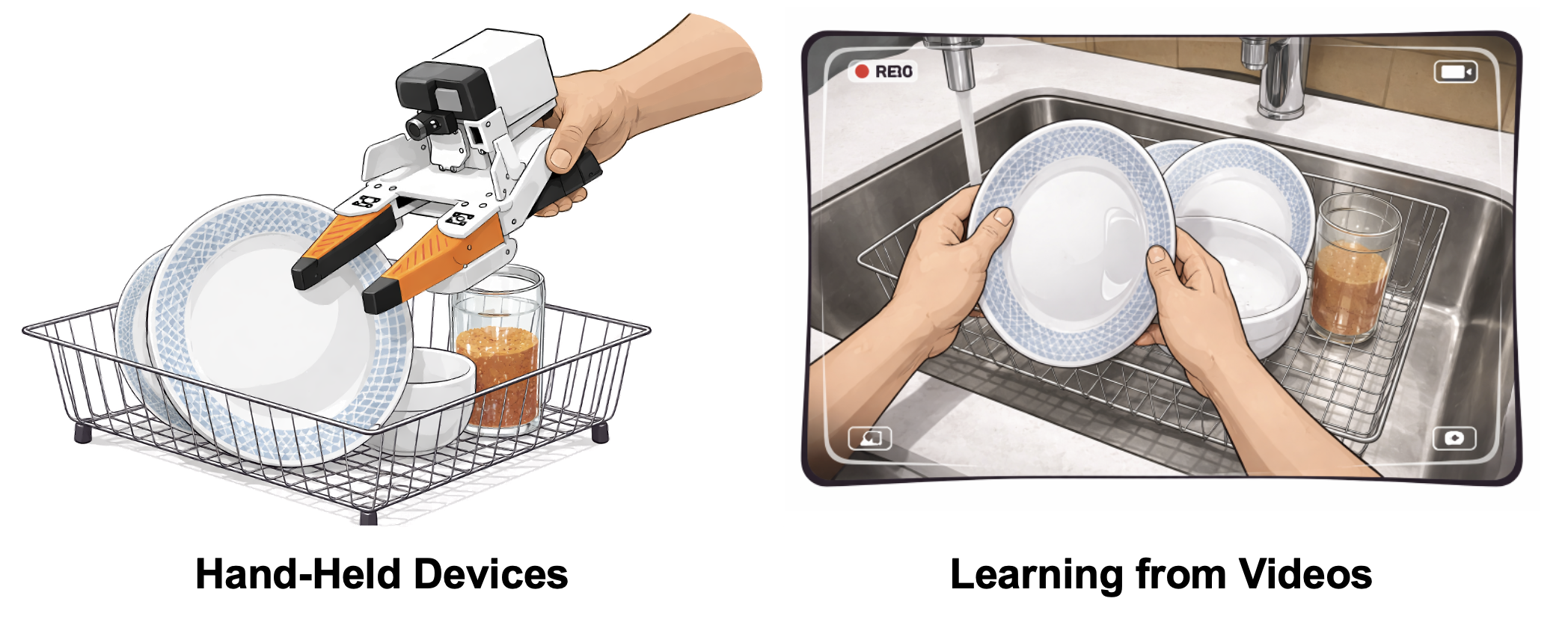
The Implicit Stiff-Controller Assumption in Learning from Wearables or Videos.
Paradigms that learn manipulation skills from human videos or wearable devices
typically treat observed next-timestep state as the action label, implicitly
assuming perfect target tracking — which our results suggest may be suboptimal
for imitation learning. Whether these gain-dependent trends generalize to such
cross-embodiment or whole-body control settings remains an open question.