
Abstract
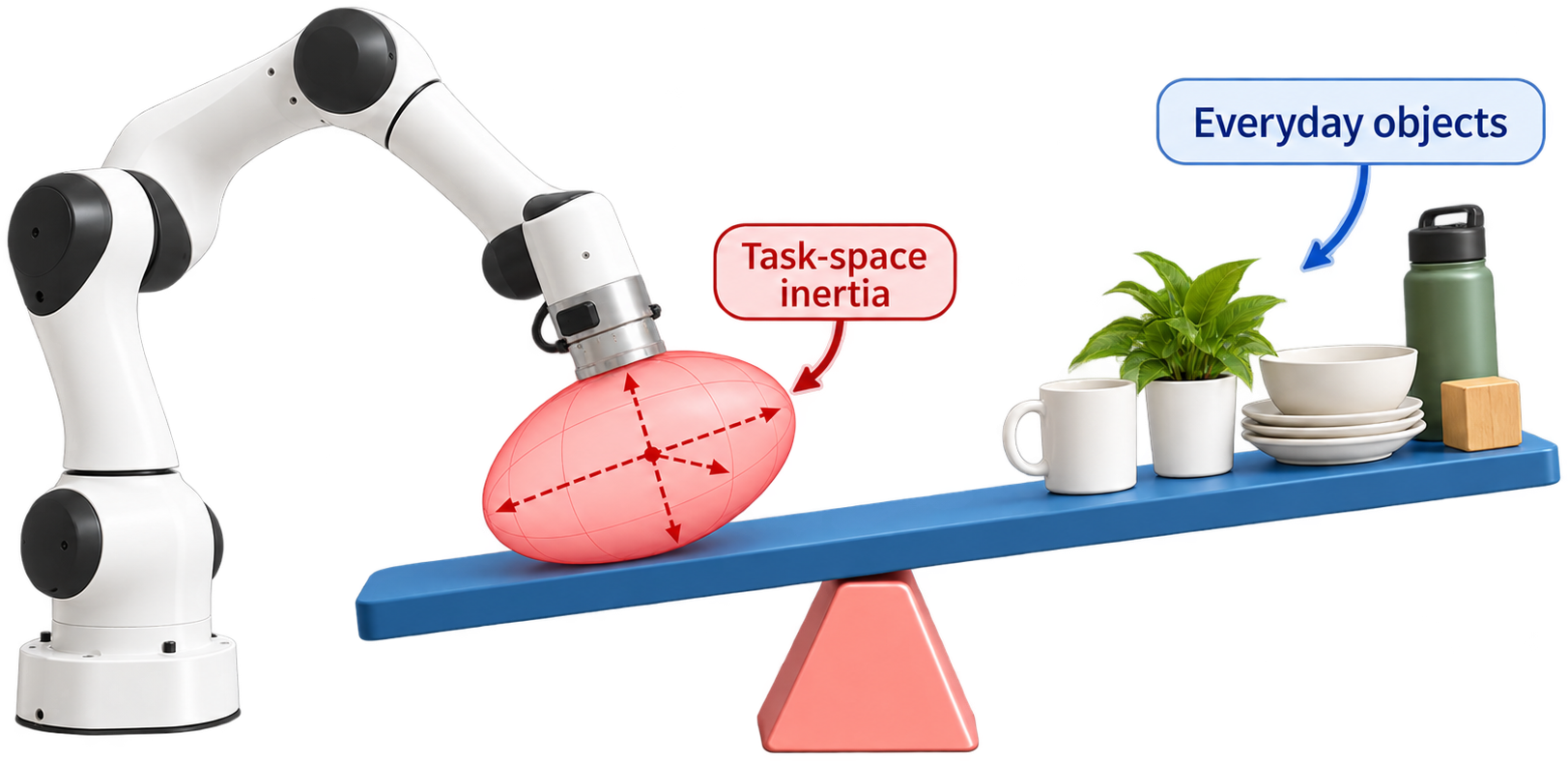
Conventional robot arms can be extremely heavy compared with the everyday objects they manipulate, creating a significant inertia mismatch at contact. Even a small accidental bump from a heavy arm can knock a light object out of place. Modern learning methods have nevertheless demonstrated a wide range of successful manipulation behaviors on these platforms, suggesting that even extreme inertia mismatch can be overcome with sufficient data. However, it remains unclear whether high inertia imposes a hidden cost on learning, potentially worsening scaling with data and lowering the performance ceiling of modern robot learning methods. We investigate this question through controlled pushing experiments that vary robot and object masses. A reinforcement-learned policy succeeds across a broad range of masses, while behavior cloning learns more reliable policies when a lighter robot manipulates a heavier object. This preference carries over to a simulated robot arm whose motors reflect more or less inertia through their gearing, even though its weight stays the same. Because new hardware is rarely an option, we then lower contact inertia on the arm one already has, either by choosing its setup before collecting data or by steering the demonstrator toward lower-inertia solutions of the task. Both improve closed-loop imitation.
Video
Robots outweigh the objects they manipulate
We audited ten public simulation datasets from robomimic Mandlekar et al. "What Matters in Learning from Offline Human Demonstrations for Robot Manipulation" (robomimic). CoRL 2021. and MimicGen Mandlekar et al. "MimicGen: A Data Generation System for Scalable Robot Learning using Human Demonstrations." CoRL 2023., human and generated demonstrations on four arm models. At every recorded contact, we computed the effective mass that the arm presents along the contact normal, from the recorded joint state and the robot model. The arms present 6 to 16 kg on average, while the objects weigh 8 to 250 g: every dataset sits 65 to 1,370 times below equal mass, further into the heavy-robot regime than even the most extreme pair of our controlled study (50 : 1).
Okay, but is this really a problem?
Picture moving a coffee mug with an excavator. Even an accidental bump can knock the mug out of place, and out of the situations a policy was trained on, not to mention the danger to people nearby. Human arms, by contrast, present far lower effective mass at the hand Shin et al. "Design and Control of a Bio-inspired Human-friendly Robot." IJRR 2010..
That intuition powered a long push in robotics to build lighter, lower-inertia arms that remove the mismatch in hardware Zinn, Roth, Khatib, Salisbury. "A New Actuation Approach for Human Friendly Robot Design." IJRR 2004.:
Large neural-network policies, trained on vast amounts of data, have made rapid progress on diverse manipulation tasks, on conventional, heavy arms Luo, Xu, Wu, Levine. "Precise and Dexterous Robotic Manipulation via Human-in-the-Loop Reinforcement Learning." Science Robotics 2025. Chi et al. "Diffusion Policy: Visuomotor Policy Learning via Action Diffusion." RSS 2023; IJRR 2025..
 HIL-SERL
UC Berkeley · Science Robotics 2025
Real-world reinforcement learning on Franka arms: whipping a block out of a Jenga tower, assembling a timing belt and a dashboard.
 π0
Physical Intelligence · 2024
One generalist policy, trained across single-arm, dual-arm and mobile robots, folding laundry, bussing tables and building boxes.
 Large Behavior Models
Toyota Research Institute · 2025
Multitask diffusion policies on bimanual Franka FR3 stations, learning new tasks from a fraction of the data.
 GEN-1
Generalist · 2026
Folding boxes on Universal Robots arms and servicing robot vacuums on Flexiv arms, live at the Automate 2026 trade show.
Click the video in front to play it; videos play from their authors' YouTube channels.
So, what do you think?
Does your robot's weight matter for policy learning?
That is half right. In our experiments RL finds successful strategies whether the robot is lighter or much heavier than the object. Behavior cloning is different: with the controller's free-space response held fixed, BC success drops sharply as the robot outweighs the object, and fitting error does not explain the drop. Jump to the BC results.
Safety is the classic reason to build low-inertia arms. We find a second one: learnability. The same small target error moves a light object much more when a heavy robot delivers it, and imitation policies pay for that. See it happen.
That matches what we find for behavior cloning. What matters, though, is not the arm's catalogue weight but its inertia at the contact: an arm geared to reflect more motor inertia is harder to imitate at the same weight, and the same arm presents less inertia in some postures than others. That lets you lower the cost without new hardware. See how.
A controlled experiment: planar T-pushing
To isolate robot–object inertia mismatch, a circular robot of mass $m_r$ pushes a T-shaped object of mass $m_o$ toward a goal. We vary both masses from $0.1$ to $5$ kg. The policy commands a position target $x_d$, held between updates, which a faster PD controller tracks:
Scaling the gains with robot mass gives every robot the same free-space response for the same target history, while preserving differences in contact dynamics. We sweep $\omega_n\in[5,40]$ rad/s and $\zeta\in[0.5,2]$, three log-spaced values each, and assume actuator force scales with robot mass, $F_{\max}=m_r a_{\max}$.
Reinforcement learning finds solutions everywhere
We train one dynamics-conditioned PPO expert Schulman et al. "Proximal Policy Optimization Algorithms." arXiv 2017. jointly across randomized robot and object masses and controller settings. It also receives a commanded finish time, $T = 2$ or $4$ s, because speed can change the strategy: a fast push may ride on momentum, while a slow one leaves time for gradual corrections.
RL discovers competent strategies at every mass pair, even when the robot is fifty times heavier than the object.
Behavior cloning pays for the mismatch
For every mass pair, we train a separate Transformer policy on the expert's demonstrations. It sees four steps of robot and object observations, predicts five absolute position targets, and executes the first before replanning.
BC degrades severely under extreme inertia mismatch: imitation favors a lighter robot pushing a heavier object.
Why: a heavy robot passes its mistakes on
Two explanations come to mind, and neither holds. The heavy-robot policies do not fit their demonstrations worse; they fit them better (switch the map above to Training MSE). Nor do lighter robots win through softer gains, although compliant gains are known to help BC Bronars, Park, Agrawal. "Tune to Learn: How Controller Gains Shape Robot Policy Learning." arXiv 2026.: because our gains scale with mass, the free-space error sensitivity $\operatorname{Var}[\delta x] = \sigma^2 k_p/2k_d = \sigma^2\omega_n/4\zeta$ Seo. "Behavior Cloning Under PD Control: A Finite-Horizon Theory of Gain-Dependent Error Amplification." arXiv 2026. is the same for every robot.
The masses matter only in contact. While robot and object move together, a small target error $e$ drives both through the controller's spring, so the object's initial acceleration is
A heavy robot ($\alpha \to 1$) passes the whole mistake on to the object, while the object's inertia absorbs a light robot's mistake. Holding the wrong target until the next policy update lets the error grow, $\delta x(\Delta) \approx \tfrac12\,\alpha\,\omega_n^2\,e\,\Delta^2$.
An imitation policy makes such mistakes at every step. With a heavy robot, each one pushes the object further from the states the demonstrations covered, consistent with BC's preference for lighter robots over whole episodes. The inner controller keeps tracking throughout, but it cannot tell whether its target suits the object.
From a point mass to a real arm
The planar robot is deliberately abstract: its inertia is a single number, $m_r$. A real arm's inertia is a matrix over its joints, and part of it comes from its motors,
Each rotor spins $N_i$ times faster than its joint, so its inertia appears $N_i^2$ times larger there. On the Flexiv arm we use, this reflected inertia is about half of $M(q)$. We therefore scale it alone, by a factor $s$, as different gearing of the same rotor would, and repeat the mass study. Because the links stay the same, so does the arm's weight.
The cost carries over to an articulated arm: BC degrades as the arm's reflected inertia grows, even though the arm's weight never changes.
Without changing the hardware
An arm geared to reflect less motor inertia would help, but changing hardware is rarely an option. Fortunately, the inertia that an object meets is not fixed by the hardware alone. At a contact point $c$ and along a contact direction $u$, the object meets the arm's directional effective mass Khatib. "Inertial Properties in Robotic Manipulation: An Object-Level Framework." IJRR 1995.
the force needed per unit acceleration of the otherwise free arm along $u$. Under operational-space control, the commanded free-space response is fixed, while the response to contact is governed by this mass Khatib. "A Unified Approach for Motion and Force Control of Robot Manipulators: The Operational Space Formulation." IEEE J. Robotics and Automation 1987., so $m(q,u)$ plays the role of $m_r$. Because the Jacobian depends on posture, however, the same arm can present very different masses to the same object.
Two levers: the setup and the demonstrator
On a fixed robot, two kinds of choices therefore set the masses along a dataset's contacts. The setup $\theta$ is everything fixed before data collection besides the hardware, such as where the task sits relative to the base, the tool and how the controller resolves redundancy. It maps each contact location $x$ to a posture and thereby defines an inertia landscape $m_\theta(x,u)$ over the task region. The demonstrator $\pi$ in turn decides which contacts occur. Together they set the inertia that demonstrations encounter,
A design lever lowers it by changing the landscape before any data exists, so every demonstrator, whether a person, a script or an RL expert, inherits the reduction. An objective lever keeps the setup and steers the demonstrator toward lower-inertia solutions among the many ways to solve the task. We study one instance of each.
Design: choose the setup before collecting data
We vary a single design variable, the height of the workspace, for the Flexiv T-pushing task. Raising the task lowers the arm's mass in the planar push directions across the task region. RL experts trained at each placement both succeed, and they carry the difference into their demonstrations.
We then train BC on each placement's demonstrations, across 36 combinations of history, prediction and execution lengths.
Placing the task in a lower-inertia region improves imitation, with the same robot, action interface and controller gains.
Because both placements use the same arm, neither its weight nor its reflected inertia can explain this gain; only its inertia at contact changed. Placement also changes the experts' strategies, so this comparison does not isolate error propagation as the cause.
Objective: steer the demonstrator
An objective lever keeps the setup and changes which contacts the demonstrations make. We train two PPO experts for 6-D cube reorientation with a Franka arm under joint-position control, so the posture is part of the expert's choice. Both share the task reward, plus a term that favors low or high directional mass $m$ along the prospective tool–cube contact normal,
The low-inertia expert takes longer to discover successful behavior, but both eventually succeed, and from the same starts they reach the cube in different postures.
Lower-inertia demonstrations improve joint-position BC, even though they are harder to fit.
What bounds each lever
Both levers improve imitation, but by less than the controlled effect of the planar study, because each has its own limit.
Hardware bounds design. A setup can only reshape the inertia that the hardware provides. Every placement, for instance, inherits the arm's reflected inertia, which costs imitation. Arms with less of it would therefore gain twice: lower contact inertia overall, and a larger share of it that design can shape.
Task redundancy bounds objectives. An objective can only choose among the ways a task can be performed. Even the Franka's lower-inertia demonstrations still meet the cube with many times its mass, and steering toward lower inertia slowed the expert's learning.
Posture variation bounds both. Unlike the point mass, an arm's inertia at contact varies along a task, so lowering it in one configuration cannot keep it low throughout. Keeping it low across whole motions ultimately calls for lighter links or less reflected inertia.
Conclusion & open directions
Robot–object inertia mismatch carries a measurable cost for learning reliable manipulation through behavior cloning. RL finds successful strategies across a broad range of masses, while BC favors a lighter robot relative to the object. The same cost appears on a realistic arm when only the inertia its motors reflect through their gearing grows, at the same weight, so arms that reflect less motor inertia, such as those with lower gear ratios, would help. Because the inertia at contact also depends on configuration, however, the arm one already has can present less of it, through a setup chosen before collecting data or a demonstrator steered toward lower-inertia solutions. One instance of each improves closed-loop BC without new hardware.
Retargeting human demonstrations
Human videos and handheld demonstrations such as UMI Chi et al. "Universal Manipulation Interface: In-The-Wild Robot Teaching Without In-The-Wild Robots." RSS 2024. do not specify the robot's posture. Among the configurations that realize a tool path, retargeting could favor lower inertia along the relevant contact directions, with the retargeting optimizer playing the demonstrator.
Teleoperation interfaces
A dynamically matched teacher arm could let the operator feel inertial resistance and favor lower-inertia motions, an objective delivered through the operator's own effort. Inverse kinematics could instead favor lower-inertia postures while tracking the operator's tool commands, a design choice that asks nothing of the operator.
Physical arms with lower contact inertia
Our arms with scaled reflected inertia exist only in simulation. Testing the same prediction on physical arms that differ mainly in contact inertia, such as low-gear-ratio arms, remains open, in part because many lack the torque interface that operational-space control requires.
Sim-to-real
Dynamics and sensing gaps push a policy off its training distribution Peng et al. "Sim-to-Real Transfer of Robotic Control with Dynamics Randomization." ICRA 2018., and the resulting action errors can alter contact and compound. Lower robot inertia relative to the object may limit that amplification, which matched-response comparisons under controlled shifts could test.
BibTeX
@misc{park2026robotsoutweigh,
  title  = {When Robots Outweigh Objects: How Inertia Mismatch Shapes Robot Policy Learning},
  author = {Park, Younghyo and Bronars, Antonia and Agrawal, Pulkit},
  year   = {2026},
  note   = {Under review}
}
Acknowledgments
We used AI tools to assist with plotting code and managing experimental runs on GPU clusters. The authors retain responsibility for the scientific content and conclusions.